higher education
Students protest higher education budget cuts
Posted on 04. Mar, 2010 by Mike.
University of Washington students joined their peers across the state and nation March 4th for a National Day of Action to protest tuition increases and cuts to financial aid programs at colleges and universities. View the video below of UW students protesting higher education budget cuts.
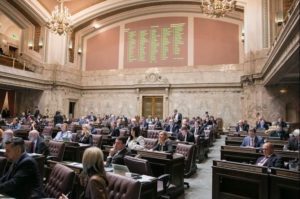
In Olympia, students at Evergreen State College marched to the state Capitol building where lawmakers are considering further cuts to higher education funding. The students were escorted from the Senate gallery after they began singing. Read more coverage from the Olympian.
Continue Reading
Video: Impact of 2010 WA State Budget on Higher Education
Posted on 03. Mar, 2010 by Maggie.
State lawmakers are considering budget cuts that will impact thousands of college and university students across the state. LEV, the Washington Student Association and the Washington Bus are working together to urge parents and students to contact their legislators.
Watch the video of two UW students, Ashwaq and Colette, as they share their struggles with college affordability and then contact your lawmakers to urge them to protect funding for higher education. Please tell them how you, your children, your grandchildren, your friends and your relatives rely on Washington’s State Need Grants and/or Work Study program in order to attend and complete college.
Video link: http://www.youtube.com/watch?v=s_nhJmmhh48
Washington’s State Need Grants serve almost 74,000 students across the state, and our Work Study program provides part-time jobs to almost 11,000 students.
Continue Reading
If you were hiding under a rock last night, you missed two great things.
Posted on 28. Jan, 2010 by Maggie.

Over a hundred young people gathered to watch the State of the Union at Olympia in a Can. Later, Maggie (left) participated in a panel discussion about higher education.
1) Obama stated his commitment to making community colleges across the country more affordable
2) the Bus held Olympia in a Can (part 1 of 3)!
The first three weeks of the legislative session have been a whirlwind of topics: the budget, pre-kindergarten, the budget, race to the top, umm the budget, new revenue sources, and did I mention that people are concerned about Washington’s budget? Not so much a ‘whirlwind of topics’ … maybe more of a black hole, actually.
Amidst the furor over our 2.6 billion dollar deficit, Washington students must know one thing. State need-grants and work study money for two and four year students are on the chopping block.
This was the hot topic last night at Grey Gallery and Lounge, where over 100 young people convened with the Bus, LEV, WSA, and UAW Local 4121 to hear and discuss how this session will affect campuses across Washington.
A few, key facts:
Washington State has over 83,000 college students receiving some form of need-based grant or work study money.
83,000 is more than a sold out Seahawks game at Qwest Field and roughly 2/3rds of all students across the state!
Cutting the state-need grant would entirely eliminate funding for 12,300 students and reduce (by more than half) the awards for 57,000 other students.
Nobody likes the idea of students taking out private loans to pay for their education-except the banks.
Check out Washington Student Association’s calendar for days of action in February and stay posted to League of Education Voters’ student Facebook page for updates on how young people can stay involved in this year’s legislative session.
Continue Reading
“Identifying the ‘Least Bad Options’ for Coping with Decreased State Support for the UW”
Posted on 19. Jan, 2010 by Maggie.
The title says it all… What will universities and community colleges across Washington do to cope with this session’s ominous budget cuts? A recent poll of UWers suggests some interesting student perspectives on the issue.
Primarily, UW students do not want the quality of their education to decrease given our State’s budget deficit. The survey results beg the question, “Are students willing to pay more tuition to maintain their current level of excellence?” and when you put it that way, then yes, it appears as though they are.
With Washington facing a 2.6 billion dollar deficit, we’re going to see some cuts to higher ed. In fact, it would appear inevitable. But does that have to mean higher tuition? It seems like UW students have a few of their own suggestions about where that money should come from. For the full report, check it out on Publicola.
Continue Reading
Tax credit for college expenses
Posted on 19. Jan, 2010 by Heather.
As we all know, college is expensive. Previously, the federal government allowed families to claim a tax credit for college expenses (Hope credit). Families can now claim the similar American Opportunity credit on their federal income tax returns.
Details from the Higher Education Coordinating Board below:
American Opportunity tax credit may help offset college expenses
OLYMPIA- Students and families who had tuition and other college-related expenses in 2009 may be eligible to claim the American Opportunity tax credit when they prepare their federal income tax returns this year.
The full tax credit, which can be claimed for college expenses incurred during the 2009 and 2010 tax years, is available to taxpayers whose modified adjusted gross income is $80,000 or less ($160,000 or less for joint filers). A reduced credit amount is available to taxpayers with adjusted gross incomes up to $90,000 ($180,000 for joint filers). If a taxpayer’s income level was not high enough during the year to incur federal income tax liability, up to 40 percent of the tax credit can be received as a refund.
American Opportunity replaces a similar tax credit provision called the Hope credit. The new credit of up $2,500 for tuition and eligible college expenses is higher than under the Hope provision. In addition, tax filers may now claim expenses incurred during the first four years of their post-secondary education rather than only the first two.
Depending on individual circumstances, the American Opportunity tax credit may not be the most advantageous tax option for all families with higher education expenses. For guidance, consult a tax expert or visit the HECB website (www.hecb.wa.gov/Paying/payingresources/AmTaxCredit.asp) for links to additional information from the Internal Revenue Service.
Continue Reading
Annual university president salary rankings out
Posted on 18. Jan, 2010 by Heather.
Every year the Chronicle of Higher Education releases the salaries and rankings of top earning public university presidents, and the latest results are out today. This is one list where Washington universities “score” highly.
On average, salaries for university presidents increased by 2.3 percent in 2008-09, compared to 7.6 percent in 2007-08. The median salary for 2008-09 was $436,111. Here are the earners of the top five compensation packages:
- $1.58 million — E. Gordon Gee, Ohio State University
- $905,000 — Mark Emmert, UW
- $810,600 — Patrick T. Harper, University of Delaware
- $797,050 — John T. Casteen III, University of Virginia
- $787,260 — Francisco G. Cigarroa, University of Texas
WSU President Elson Floyd came in at #16 with a compensation package of $648,000.
Find additional coverage here and here.
Continue Reading
HEC Board meeting today
Posted on 27. Oct, 2009 by Heather.
The Higher Education Coordinating Board is meeting today at UW-Tacoma. The complete meeting packet is available here.
Continue Reading
It’s all about completion!
Posted on 15. Oct, 2009 by Bonnie.
What does this mean for Washington students? More opportunity that should lead to more people earning a family-wage salary and fulfilling careers. Awesome.
SEATTLE — The Washington State Board for Community and Technical Colleges (SBCTC) is launching the Washington State Student Completion Initiative aimed at dramatically increasing community college completion rates. The initiative, one of the most comprehensive completion efforts in the country, will launch new programs and expand successful pilot programs aimed at addressing key barriers to student success.
The initiative is supported by the state Legislature, a $5.3 million investment by the Bill & Melinda Gates Foundation, and $800,000 from the Ford Foundation.
“As Washington competes in the global economy, it is critical that we have the most highly skilled workforce available,” Gov. Chris Gregoire said. “That starts with our community and technical colleges. That’s why I have supported their innovative student completion initiatives in past state budgets and am so pleased to hear about this partnership with the Gates and Ford foundations, which will catapult their efforts even further.”
In today’s global economy, a college degree or postsecondary certificate is required to obtain a family-wage job. According to the federal Bureau of Labor Statistics, jobs for community college graduates will grow at a rate nearly twice as fast as the national average between 2006 and 2016. Nationally, only about 28 percent of first-time, full-time students at two-year institutions earn an associate degree within three years of enrolling. Washington is one of only a handful of states that is working aggressively to increase these percentages.
“Low-income young adults rely on community and technical colleges to get the skills they need in today’s economy, but many are struggling to succeed despite their best efforts,” said Jan Yoshiwara, SBCTC’s deputy executive director for education. “This partnership is funding some of the most innovative approaches to teaching and learning that will help us move more students further and faster to educational and economic success.”
The Washington State Student Completion Initiative will focus state and local attention on several “key achievement points” that research shows students must pass on the road to graduation, among them successfully completing pre-college or other remedial courses and completing a college-level math course.
“Getting more students into college means little if we’re not also making the effort to help them graduate,” said Hilary Pennington, director of Education, Postsecondary Success and Special Initiatives at the Bill & Melinda Gates Foundation. “Washington state has an inspiring track record of developing innovative and effective ways to do just that.”
Several Washington state programs already serve as national models for boosting student completion. These programs will be expanded over the four years of the Washington State Student Completion Initiative:
- The state’s I-BEST program combines basic academic courses and career skills classes to ensure that the least-prepared students not only complete college, but are competitive in the workforce upon graduation. Program evaluations suggest that I-BEST students are almost four times more likely to earn a credential or degree than similar students who were not enrolled in I-BEST. Under this initiative, Washington state will expand I-BEST to new pre-college and college-level degree programs. (I-BEST stands for Integrated Basic Education and Skills Training.)
- Washington’s Student Achievement Initiative provides financial incentives for institutions based on increases in student milestones that have demonstrated key linkages to college completion. It represents a significant shift from traditional funding, which typically is based solely on a college’s enrollment. During the pilot phase of the initiative, colleges served the same number of students but increased student achievement by nearly 5 percent. The greatest gains were a 10 percent boost in basic skills and nearly a 7 percent jump in college readiness. This initiative will expand the financial incentives to those colleges that see higher numbers of students who reach key graduation milestones.
The state will launch two new programs under the Washington State Student Completion Initiative:
- Strengthen and expand access to the colleges’ gatekeeper courses. There are 80 high-enrollment, gatekeeper and pre-college courses that most students must take to successfully earn a degree. Too often, students don’t complete these courses, can’t find an open section, or can’t afford the textbook. SBCTC and the 34 colleges will research, redesign, teach, and assess the 80 courses to improve completion rates through best practices in instructional design and active learning. This online initiative will reduce total student costs (an estimated $6.5 million a year) with open textbooks, course packs, existing library resources, and other open educational resources. All 80 courses will be digital, so faculty can select and continually improve courses, colleges can offer additional online or blended sections, and the courses can be shared throughout the college system and with the rest of the world. The state aims to achieve 95 percent completion rates in all redesigned high-enrollment gatekeeper courses.
- Take steps to improve students’ success in pre-college and college math. Math continues to be the major hurdle for students to complete certificates and degrees. More than 56,000 community college students in Washington are required to take remedial-level math (a 9 percent increase in the last year alone). Under this initiative, a coalition of seven colleges will focus on improving student math achievement by making substantive changes in curriculum, instructional practices and teacher support, and assessment. The program aims to increase successful completion of remedial math courses by 15 percent.
“Too many young people enroll in community colleges expecting educational advancement and broader opportunity—only to find a revolving door,” said Alison Bernstein, vice president of education, creativity and free expression at the Ford Foundation. “We are pleased to support initiatives such as Student Achievement that offer large numbers of students the chance to reach their ultimate goals of obtaining AA and BA degrees. We want students to complete their higher education, not just sample it.”
The grants announced today advance efforts by the Gates Foundation and the Ford Foundation to help increase the number of people in the United States who successfully earn a degree or certificate beyond high school.
Continue Reading
Tell Congress to cutout the middleman
Posted on 14. Sep, 2009 by Bonnie.
What happens when you cut out the middleman? You help kids and save money-in this case, more than $80 billion!
This week, the U.S. House of Representatives will vote on the Student Aid and Fiscal Responsibility Act, which would increase early learning and higher education opportunities for millions of kids.1
This legislation will have a profound impact on the future of our kids. By cutting out the middlemen in federal government student loans, more than $80 billion will be saved over the next 10 years.
The savings will be used to:
- Ensure young children enter kindergarten ready to succeed by creating an Early Learning Challenge Fund to provide states with $8 billion in competitive grants over 8 years. This investment would improve outcomes for all children and especially at-risk children-resulting in higher graduation rates, higher rates of college attendance, and higher earnings at work.
- Prepare more students for the workforce by improving access and affordability to higher education through expansion of loan and grant programs, strengthening our nation’s community college system, and keeping interest rates low for students receiving need-based federal loans.
Washington State’s delegation in the U.S. House of Representatives will play a key role in moving this legislation forward. They will vote on this legislation this week. That’s why we need you to take action today!
This legislation is critical to our state and nation’s future in helping to improve outcomes for millions of kids.
1Information on the Student Aid and Fiscal Responsibility Act
Continue Reading
Education is hot, debt is not.
Posted on 03. Sep, 2009 by Maggie.
Today, the Wall Street Journal published an article stating that student loan borrowing grew 25% in the last year (and has been steadily rising for some time now). “Today, two-thirds of college students borrow to pay for college, and their average debt load is $23,186 by the time they graduate.” For many of us, this is no surprise.
The article goes on to talk about the consequences of a young generation amassing such measurable amounts of debt at such an early age-the effects of which I have been feeling myself! Graduated 20 somethings are postponing important life steps such as buying a home or starting a family due to debt.
This sucks. Walking around with $20,000 worth of debt on your shoulders doesn’t do much for one’s moral. But what upsets me most is who is BENEFITING from student debt. Private lenders!
The House of Representatives is slated to weigh in on this issue very soon. The Student Aid and Fiscal Responsibility Act (SAFRA) breezed through the House Committee on Education and Labor, but it’s going to need a lot of support. I’m urging all students out there to contact your House Rep and tell them we’re tired. Tired of debt and tired of private companies making money off our debt. While you’re at it, send that very message to Senator Murray. We need a companion senate bill to support SAFRA and she can do it!
Education is hot, debt is not. Private lenders collecting interest off my federal loans? Definitely not hot. Let’s change this.